Our first suspect: what makes a brilliant economist?
Build the perfect economist.
Pick the ONE superpower a proper economist cannot do without.
VOTE: WHICH SUPERPOWER WINS?
Meet your economist.
All four skills start at an assumed 75/100. Class votes boost each one: breadth matters. Our economist is fictional.
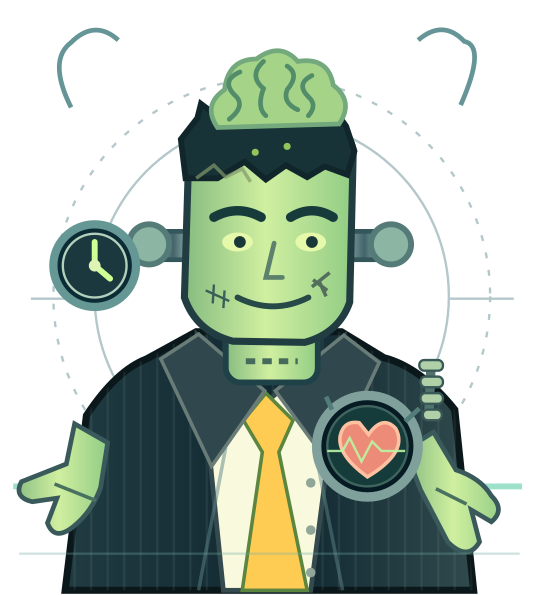
Eight findings. One index. Watch the same creature rise and fall.
MONSTER INDEX
Economics Network survey (2019), pp. 3–5
What must students still learn to do for themselves?
AI changes the teaching question.
AI can finish the task. Did the student learn?
Change the work. Test the learning.
An impressive score. But what happens when AI arrives?
The employer test established the skills. The second test asks what changes when AI can produce more of the routine work.
AI can deliver the answer. This experiment asks whether the student still practises the economic thinking that produces and challenges it.
START MAKING TROUBLE.
STOP TEACHING ANSWERS.
A correct answer may show that a student can follow a worked route. It does not always show that they can recognise when the route stops working.
TEACHING MOVE: Begin with a believable claim. Students commit to a view, defend it, encounter evidence that challenges it, then use economics to build a more defensible explanation.
START MAKING TROUBLE.
Our Capabilities research warns that better AI-assisted coursework need not mean stronger adaptability. Our Scaffolding research shows why students must lead the learning process rather than rely on AI to do it for them.
ASSESSMENT MOVE: The AI Skills ePortfolio makes students show their decisions: what they questioned, which evidence mattered, what changed and why their verdict survives.
Begin with a disputed claim.
High profits mean a safe bank. Do they?
Make the learning visible.
From our research: a polished AI-assisted result may conceal how well a student could adapt independently. AI can support thinking, but submitting its answer cannot establish that the student learned to reason.
Student’s job: Across weekly tasks, use AI to generate or challenge explanations, test evidence and alternatives, and explain what you accepted, rejected or revised.